

1 And God spake all these words, saying,…
8 Remember the sabbath day, to keep it holy.
— Exodus 20:1,8-11 (KJV)
9 Six days shalt thou labour, and do all thy work:
10 But the seventh day is the sabbath of the LORD thy God: in it thou shalt not do any work, thou, nor thy son, nor thy daughter, thy manservant, nor thy maidservant, nor thy cattle, nor thy stranger that is within thy gates:
11 For in six days the LORD made heaven and earth, the sea, and all that in them is, and rested the seventh day: wherefore the LORD blessed the sabbath day, and hallowed it.
The fourth commandment calls us to rest from our work on the seventh day of the week. In the Bible, days begin at sunset, so the Sabbath runs from Friday sunset to Saturday sunset. During those hours, we set the day apart for God. For six days we work. Then, on the seventh, we stop, just as God rested after creating the world.
This is the longest of the Ten Commandments. It’s also the only one that begins with “remember.” In other words, God didn’t introduce the Sabbath as something new at Sinai. Instead, He reminded His people of a day He had already made holy at creation.
This study follows the Sabbath through the whole Bible, from Eden to the new earth. Along the way, it answers the questions most people ask. Was the Sabbath changed? Is it only for the Jews? And what about the verses that mention the first day of the week?
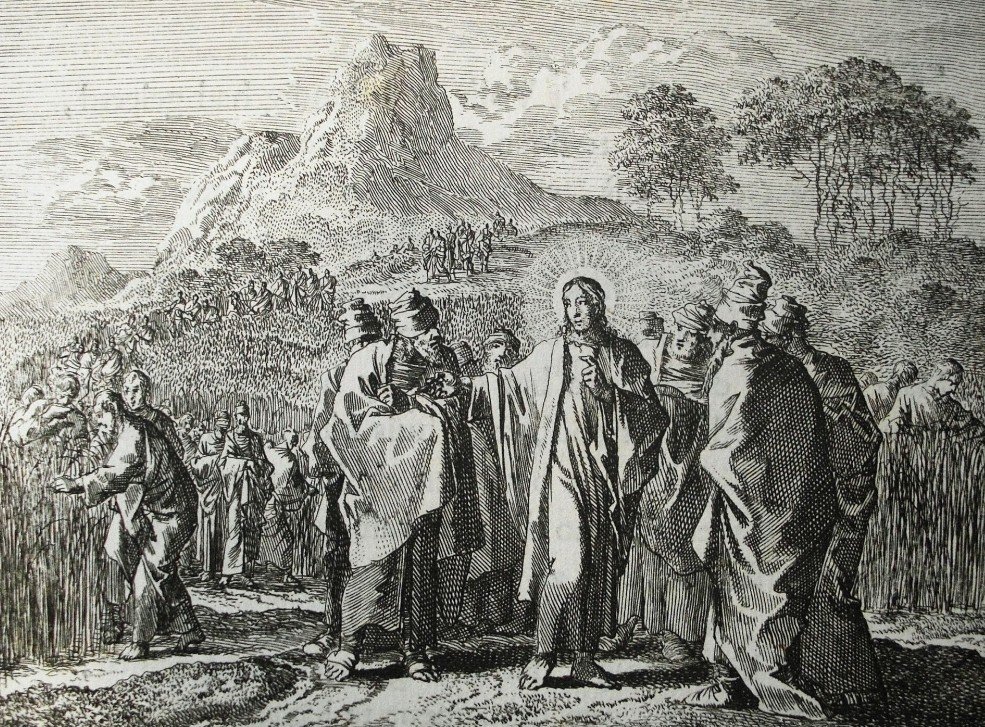
Download the free Sabbath Bible-marking guide.
It walks you through marking the key Sabbath verses in your own Bible, so you can study them again or share them with a friend. It also includes Sabbath ideas for families.
When is the Sabbath?
The Sabbath is the seventh day of the week, which we call Saturday. In the Bible, days begin at sundown. The creation account describes each day as “the evening and the morning” (Genesis 1:5), and God told Israel to keep His holy days “from even unto even” (Leviticus 23:32). So the Sabbath begins at sunset Friday and ends at sunset Saturday.
The Gospels make the order of the week clear. Jesus died on “the preparation” day, the women “rested the sabbath day according to the commandment,” and they came to the tomb “upon the first day of the week” (Luke 23:54-24:1). Most Christians call these days Good Friday, Saturday, and Easter Sunday. Even Christians who worship on Sunday agree about which day is the seventh.
Three ways Christians understand the Sabbath
Christians who love the Lord have come to different conclusions about this commandment.
- Sunday is the Lord’s Day. Many Christians, including Catholics and most Protestants, worship on Sunday because Jesus rose on the first day of the week. Some believe the Sabbath’s meaning moved to Sunday. Others see Sunday as a new day of Christian worship.
- No particular day is required. Others believe Jesus fulfilled the Sabbath, we are no longer under the law, Christ Himself is our rest, and every day can be dedicated to God. Or that the Sabbath is for the Jews.
- The seventh day is still the Sabbath. Seventh-day Adventists, Seventh Day Baptists, and other Sabbath-keeping Christians believe God blessed the seventh day at creation, wrote it into His law, and never changed it. Jesus told us to keep His commandments if we love Him.
Which view does Scripture support?
The clearest way to find out is to follow the Sabbath through the Bible from beginning to end.
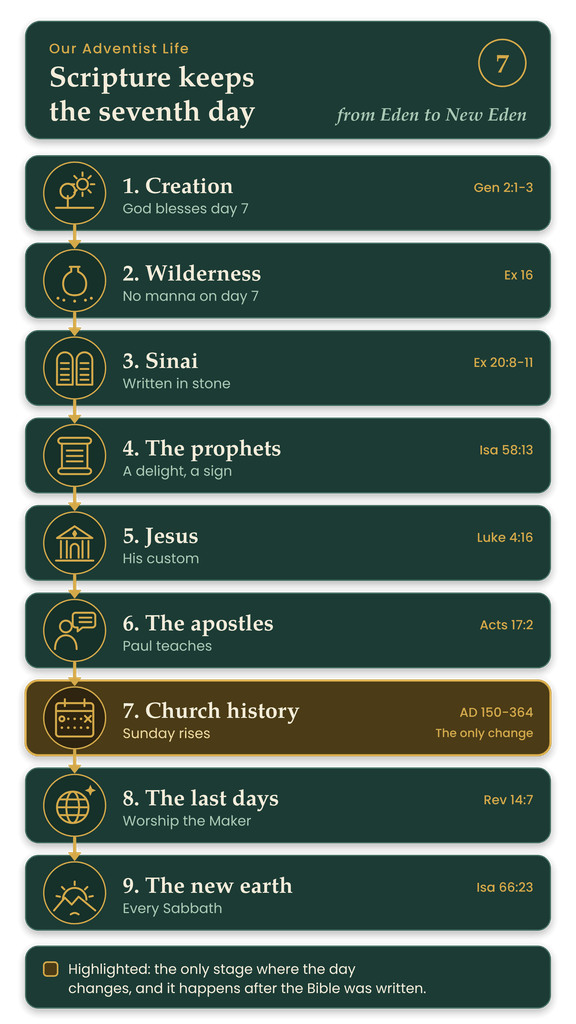
The Sabbath from Eden to New Eden
The seventh day appears at every stage of the Bible story, from creation to the new earth. The only change comes centuries after the last book of the Bible was written.
1. Creation: a gift before sin, before Israel
“And on the seventh day God ended his work which he had made; and he rested on the seventh day … And God blessed the seventh day, and sanctified it” (Genesis 2:2-3).
God did three things to the seventh day: He rested on it, blessed it, and sanctified it, setting it apart as holy.
This happened before sin, before Abraham, and more than two thousand years before there was a Jewish nation. That’s why Jesus said, “The sabbath was made for man” (Mark 2:27). The Greek word for “man,” anthropos, means humankind.
The Sabbath is a gift for everyone.
2. The wilderness: kept before Sinai
Israel was already keeping the Sabbath before they reached Mount Sinai. God sent manna six days a week, and on the sixth day the people gathered twice as much.
When some went out to gather on the seventh day anyway, God asked, “How long refuse ye to keep my commandments and my laws?” (Exodus 16:22-30).
The Sabbath was already a command.
3. Sinai: written in stone
At Sinai, God spoke the Ten Commandments aloud and wrote them “with the finger of God” on stone (Exodus 31:18). The fourth commandment begins with “remember,” pointing back to creation, and gives creation as its reason: “For in six days the LORD made heaven and earth” (Exodus 20:11).
It reaches everyone in the household: children, servants, visitors, and even working animals.
Forty years later, Moses repeats them with an added reason: “remember that thou wast a servant in the land of Egypt, and that the LORD thy God brought thee out” (Deuteronomy 5:15). He was reading them to a new generation, to remember what happened and why it is important.
So the Sabbath points to God as both Creator and Redeemer. God also called it “a sign between me and you throughout your generations” and “a perpetual covenant” (Exodus 31:13-17).
As we saw in our study of the third commandment, it’s the one commandment that contains God’s name, His title as Creator, and His territory, like an official seal.
4. The prophets: a delight and a sign
The prophets never treated the Sabbath as a burden or as Israel’s private possession. Isaiah promised that foreigners who “keepeth the sabbath from polluting it” would be brought to God’s holy mountain, “for mine house shall be called an house of prayer for all people” (Isaiah 56:2-7).
He called the Sabbath “a delight” (Isaiah 58:13-14). Ezekiel called it a sign “that they might know that I am the LORD that sanctify them” (Ezekiel 20:12, 20).
After the exile, Nehemiah shut the city gates to stop Sabbath trading (Nehemiah 13:15-22).
5. Jesus: His custom
Jesus kept the Sabbath all His life.
Going to the synagogue on the Sabbath was his custom (Luke 4:16). He often healed on the Sabbath, which angered religious leaders who had buried the day under their own rules. But He wasn’t breaking it. He was restoring its purpose: “it is lawful to do well on the sabbath days” (Matthew 12:12). And He called Himself “Lord also of the sabbath” (Mark 2:28).
What about Jesus coming to fulfil the law (Matthew 5:17)?
Some take this to mean He completed the law so we no longer need to keep it. But in the next verses, Jesus said not one jot would pass from the law “till heaven and earth pass,” and warned against teaching people to break even the least commandment (Matthew 5:18-19).
The Greek word for “fulfil,” pleroo, means to fill up or make full. Jesus fulfilled the law in two ways. First, He kept it perfectly, living out its full meaning: “I have kept my Father’s commandments” (John 15:10). Second, He taught its full meaning. In the verses that follow, He showed that the law reaches the heart. The command against murder also forbids the hatred that leads to it, and the command against adultery also forbids lust (Matthew 5:21-28).
Jesus didn’t empty the commandments. He filled them full, and that includes the fourth.
Jesus even expected His followers to keep the Sabbath decades after His resurrection. Warning them about Jerusalem’s destruction in AD 70, He said, “pray ye that your flight be not in the winter, neither on the sabbath day” (Matthew 24:20).
And in death, He rested in the tomb over the Sabbath, as His followers “rested the sabbath day according to the commandment” (Luke 23:56).
6. The apostles: every Sabbath
After the resurrection, the apostles kept teaching on the Sabbath.
Paul reasoned in the synagogue on the Sabbath, “as his manner was” (Acts 17:2). In Corinth, he taught “every sabbath” for a year and a half (Acts 18:4, 11). In Philippi, where there was no synagogue, he met with believers by a river on the Sabbath (Acts 16:13).
The clearest example is in Antioch. After Paul preached in the synagogue, the Gentiles asked him to speak to them again “the next sabbath.” If Sunday had replaced the Sabbath, this was the perfect moment to say so. Instead, “the next sabbath day came almost the whole city together to hear the word of God” (Acts 13:42-44).
Hebrews, written to believers after the cross, says, “There remaineth therefore a rest to the people of God” (Hebrews 4:9). The Greek word here is sabbatismos: a Sabbath-keeping.
7. Church history: how Sunday rose
No Bible verse moved the Sabbath to Sunday. The shift happened gradually, after the apostles were gone.
- Around AD 150, Justin Martyr described Christians in Rome gathering on Sunday, “the day of the sun,” to honor the resurrection (First Apology, ch. 67). Many historians connect the early shift, especially in Rome, to Christians wanting to distance themselves from Jews, who faced heavy Roman persecution after the Jewish revolts. Adventist scholar Samuele Bacchiocchi researched this question in depth, and his study was first published by the Pontifical Gregorian University Press in Rome.
- In AD 321, Emperor Constantine made “the venerable day of the sun” an official day of rest across the Roman Empire.
- Around AD 364, the Council of Laodicea ruled that Christians must not rest on the Sabbath but work on that day, and honor the Lord’s Day instead (canon 29).
The Catholic Church teaches that Sunday honors Christ’s resurrection and fulfills the meaning of the Sabbath (Catechism of the Catholic Church, 2175). It bases this on Church tradition and authority rather than on a Bible verse, and some older catechisms pointed to the change as an example of that authority. Adventists believe no one has the authority to change God’s law, and they see a warning about this in Daniel 7:25, which describes a power that would “think to change times and laws.”
Yet the Sabbath never disappeared.
Christians in various places kept it through the centuries. The Ethiopian Orthodox Church still honors the seventh day alongside Sunday, and Seventh Day Baptists kept it in England in the 1600s and in America from 1671. In 1844, a Seventh Day Baptist named Rachel Oakes Preston shared the Sabbath with a group of Adventist believers in Washington, New Hampshire. Through Bible study, the early Adventists came to see it as part of God’s last-day message, and the Seventh-day Adventist Church took its name from it.
8. The last days: worship the Creator
Revelation 14 describes God’s final message to the world. The first angel calls everyone to “worship him that made heaven, and earth, and the sea, and the fountains of waters” (Revelation 14:6-7). That wording echoes the fourth commandment: “the LORD made heaven and earth, the sea” (Exodus 20:11). God’s people are then described as those who “keep the commandments of God, and the faith of Jesus” (Revelation 14:12).
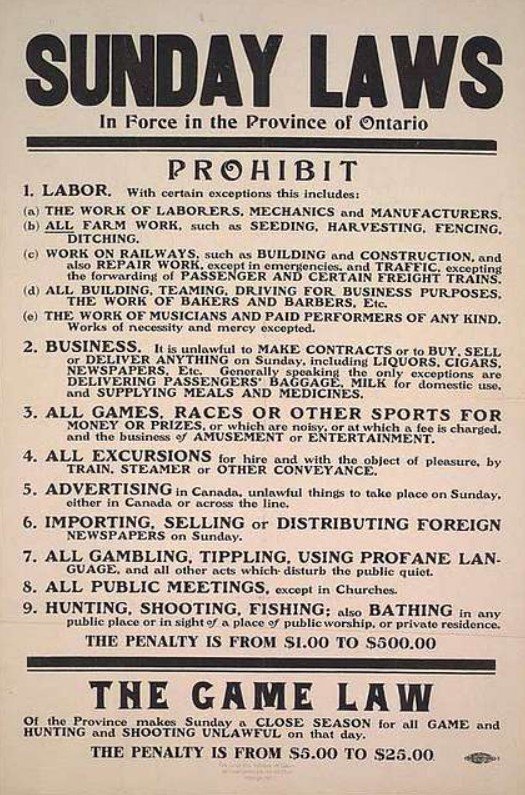
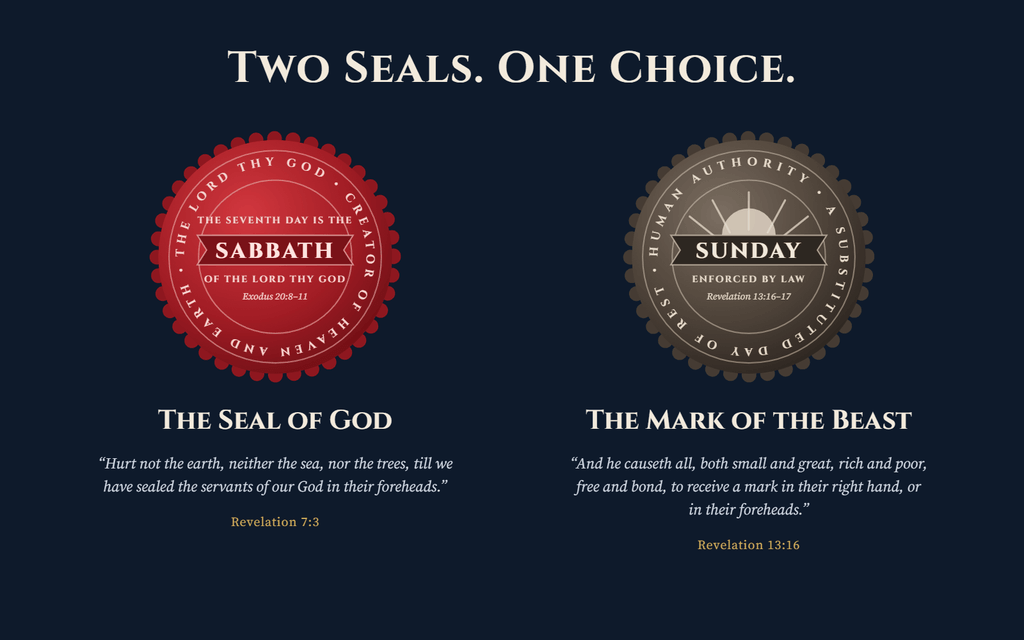
On the other side is the mark of the beast (Revelation 13:16-17; 14:9-11). Adventists believe the final conflict will center on worship, and that the Sabbath will become the visible test between God’s seal and the beast’s mark (Revelation 7:2-3; Ezekiel 20:12). But Adventists do not believe anyone has the mark of the beast today. It will be received only when Sunday observance is enforced by law and people knowingly choose it over God’s command.
Christians who worship on Sunday in sincerity are not lost, and many will be among God’s people.
9. The new earth: Sabbath to Sabbath
The story ends where it began.
In the new earth, God says, “from one sabbath to another, shall all flesh come to worship before me” (Isaiah 66:22-23). The Sabbath began in a perfect world, and it will continue forever in the world made new.
Ellen White captured what the Sabbath means between those two gardens:
“The Sabbath is a golden clasp that unites God and His people.” (Testimonies for the Church, vol. 6, p. 351)
What about the verses used to support Sunday worship?
Christians who worship on Sunday usually point to a handful of verses. Here is each one, the argument made from it, and what the text actually says.
| Verse | The argument for Sunday | What the text actually says |
|---|---|---|
| Matthew 28:1; Mark 16:9 | Jesus rose on the first day, so Sunday became the Christian day of worship. | Jesus did rise on the first day, but no verse makes that day holy or commands rest on it. Matthew still calls the seventh day “the sabbath” after the resurrection. The Bible’s memorial of the resurrection is baptism, not a day (Romans 6:3-5). |
| John 20:19 | The disciples met the evening of the resurrection, the first Christian Sunday service. | They were hiding behind shut doors “for fear of the Jews,” and they still didn’t believe He had risen (Mark 16:14). It wasn’t a worship service. |
| John 20:26 | “After eight days” Jesus met them again, showing a Sunday pattern. | The text records a meeting to convince Thomas, not a command. No day is called holy. |
| Acts 2:1 | The Holy Spirit came at Pentecost, a Sunday, so the church began on Sunday. | Pentecost was a yearly feast set by Leviticus 23:15-16, not a weekly day of worship. The verse describes what happened, not a change to the Sabbath. |
| Acts 20:7 | Believers gathered “to break bread” on the first day, showing regular Sunday worship. | This was a farewell meeting before Paul left. By biblical time, the first day began at sunset, so it was likely Saturday night, and the New English Bible translates it that way. Believers also broke bread “daily” (Acts 2:46), so breaking bread doesn’t mark a holy day. |
| 1 Corinthians 16:2 | Offerings were collected at Sunday church services. | “Let every one of you lay by him in store” means setting money aside at home, so no collections would be needed when Paul arrived. |
| Revelation 1:10 | “The Lord’s day” means Sunday. | The verse doesn’t name the day. Scripture calls the Sabbath the Lord’s day: “my holy day” (Isaiah 58:13), and Jesus is “Lord also of the sabbath” (Mark 2:28). Using “the Lord’s day” for Sunday comes from writers after the New Testament. |
| Colossians 2:16-17 | Paul said not to let anyone judge us about “the sabbath days,” so the Sabbath is no longer binding. | Paul lists “an holyday, or of the new moon, or of the sabbath days” as “a shadow of things to come.” The Old Testament uses the same trio for Israel’s yearly feasts and ceremonial sabbaths (1 Chronicles 23:31; Ezekiel 45:17), which pointed forward to Christ. The weekly Sabbath points back to creation, so it can’t be a shadow of something to come. |
| Romans 14:5-6 | “One man esteemeth one day above another,” so each Christian chooses their own day. | The chapter is about disputes over eating and fasting. It never mentions the Sabbath or the Ten Commandments. |
| Galatians 4:9-10 | Observing “days, and months” is a return to bondage. | Paul is warning Gentile converts against returning to the “weak and beggarly elements” they served when they “knew not God” (Galatians 4:8). He isn’t describing the Sabbath God blessed at creation. |
The phrase “first day of the week” appears eight times in the New Testament (Matthew 28:1; Mark 16:2, 9; Luke 24:1; John 20:1, 19; Acts 20:7; 1 Corinthians 16:2). None of the eight, and none of the passages above, calls Sunday holy, commands rest on it, or says the Sabbath was changed.
How do we keep the Sabbath holy?
God wants the Sabbath to be a delight, not a burden.
He promised joy to those who “call the sabbath a delight, the holy of the LORD, honourable” (Isaiah 58:13-14).
It starts on Friday. In the Bible, Friday was the preparation day (Luke 23:54). Israel prepared food ahead of time (Exodus 16:23). Finishing chores, cooking, and errands before sunset frees the Sabbath for rest instead of work.
What we set aside: our regular jobs, business, shopping, and household chores. Nehemiah stopped buying and selling in Jerusalem on the Sabbath (Nehemiah 13:15-22). The commandment also says not to make others work for us, including employees and even animals (Exodus 20:10).
What fills the day: worship with other believers, Bible study, prayer, rest, time with family, enjoying God’s creation, and doing good for others. Jesus showed that acts of mercy and meeting real needs are right on the Sabbath (Matthew 12:10-12; Luke 14:5).
With children, the Sabbath can be the best day of the week. Many Adventist families keep special Sabbath books, Bible puzzles, or toys that only come out that day. Nature walks, visiting grandparents or lonely neighbors, and a special Friday evening meal help children see the Sabbath as a gift, not a list of “no’s.”
Above all, we keep the Sabbath because we love God. “If ye love me, keep my commandments” (John 14:15).
Obedience doesn’t earn salvation. It’s our response to the grace that saved us (Ephesians 2:8-10; 1 John 5:3).
Learn more about the Ten Commandments.
Other sources of information:
Objections about the Sabbath
No. God made the Sabbath at creation, more than two thousand years before Abraham (Genesis 2:1-3).
Jesus said it “was made for man,” meaning all humanity (Mark 2:27). Even at Sinai, the commandment included “thy stranger that is within thy gates” (Exodus 20:10). Isaiah promised blessing to foreigners who kept it (Isaiah 56:6-7), and foresaw “all flesh” worshiping from one Sabbath to another in the new earth (Isaiah 66:22-23).
No verse records Jesus abolishing the Sabbath or changing it to Sunday. He said He didn’t come to destroy the law (Matthew 5:17-19), He kept the Sabbath all His life (Luke 4:16), and His followers kept it after His resurrection (Luke 23:56; Acts 13:42-44).
Jesus does offer true rest: “Come unto me, all ye that labour and are heavy laden, and I will give you rest” (Matthew 11:28). Some Christians believe this rest replaces the weekly Sabbath. But Hebrews, written after the cross, says a sabbatismos “remaineth” for God’s people (Hebrews 4:9-10).
The weekly Sabbath doesn’t compete with resting in Christ. It’s the day God set aside to practice it: we stop our own work and trust His.
God didn’t bless just any day. He “blessed the seventh day, and sanctified it” (Genesis 2:3; Exodus 20:11).
Think of an anniversary.
You can love your spouse every day, but the anniversary is a specific date that remembers a specific event. The Sabbath is God’s memorial of creation, tied to the day He rested. We can and should worship God every day, but only the seventh day was set apart as holy.
We are saved by grace through faith in Jesus, not by keeping the Sabbath or any other commandment (Ephesians 2:8-9). In fact, the Sabbath is a sign that God is the One who makes us holy (Ezekiel 20:12).
Resting on it is a weekly reminder that we trust His work, not ours (Hebrews 4:10). Those who are saved keep it as a response of love, not as a way to earn His favor.
This is a real struggle for many people. Jesus showed that works of mercy are right on the Sabbath, like caring for the sick or pulling an animal out of a pit (Matthew 12:11-12; Luke 14:5). That’s why Adventist hospitals stay open on the Sabbath, focusing on patient care rather than routine business.
For other jobs, start by asking your employer for Sabbath off. In the U.S. and many other countries, employers must make reasonable accommodations for religious practice, and many will trade shifts or adjust schedules.
When changes aren’t possible, Sabbath-keepers have sometimes chosen to change jobs, trusting God’s promise to provide for those who put Him first (Matthew 6:33). Every situation is different, and talking with your pastor can help you think it through.
No. When the Gregorian calendar replaced the Julian calendar in 1582, ten dates were skipped, but the days of the week weren’t: Thursday, October 4 was followed by Friday, October 15. The weekly cycle continued unbroken. Jewish communities have kept the seventh-day Sabbath continuously since Bible times. And in many languages, the name for Saturday comes from the word “Sabbath”: Spanish sábado, Italian sabato, and Russian subbota, for example.
Living the fourth commandment
When I became an Adventist, I had a great Monday-through-Friday job with excellent benefits. The catch was that I sometimes had to be on call over the weekend, whenever we pushed an update to a client’s website or launched a marketing campaign.
So I asked for a religious accommodation, and I got it. But as a manager, I was asked to have someone else on my team cover the Sabbath for me. I had to explain that I couldn’t do that either. The commandment doesn’t only say I shouldn’t work. It says not to make others work in my place (Exodus 20:10). We worked it out together. The solution turned out to be simple: plan better during the week, and stop pushing updates on Fridays.
I’ve also come to love how countercultural the Sabbath is. So much of our work culture expects us to always be available and always be on call. We’re told that’s what it takes to be a team player, or to keep our jobs. But living that way is exhausting, and it isn’t healthy. The Sabbath is God’s weekly reminder that I’m not a machine. “The sabbath was made for man” (Mark 2:27), and I’m grateful for a God who commands me to rest.
Best of all, the Sabbath has given me more time to simply enjoy my family and my kids.
Summary
- The Sabbath began at creation, before sin and before Israel (Genesis 2:1-3; Mark 2:27).
- It’s the seventh day, Friday sunset to Saturday sunset (Leviticus 23:32; Luke 23:54-24:1).
- Scripture keeps it at every stage: the wilderness, Sinai, the prophets, Jesus, and the apostles (Exodus 16; Luke 4:16; Acts 17:2).
- No verse changes it. None of the eight “first day” verses makes Sunday holy. The change came through church history (Daniel 7:25).
- It’s central in the last days, when God calls the world to worship the Creator (Revelation 14:7, 12).
- It continues forever in the new earth (Isaiah 66:22-23).
Get a free Sabbath guide to Jesus’ day of rest
Use this free guide to mark key Sabbath verses and discover family Sabbath ideas.

Our Adventist Life is a dedicated online evangelist and mother of two, deeply rooted in her Seventh-day Adventist faith. With over 15 years of experience in creating and optimizing digital content, she brings a unique blend of professional expertise and spiritual insight to her work. Her passion lies in exploring Biblical truths and their practical applications in daily living, self-care, and family nurturing. Through her writing, she aims to inspire and guide her readers toward a more fulfilling Christian lifestyle, drawing from her own experiences as a parent and a follower of Christ. Her thoughtful and engaging content reflects her commitment to sharing the love and wisdom found in the Scriptures with a modern audience living in the end times.