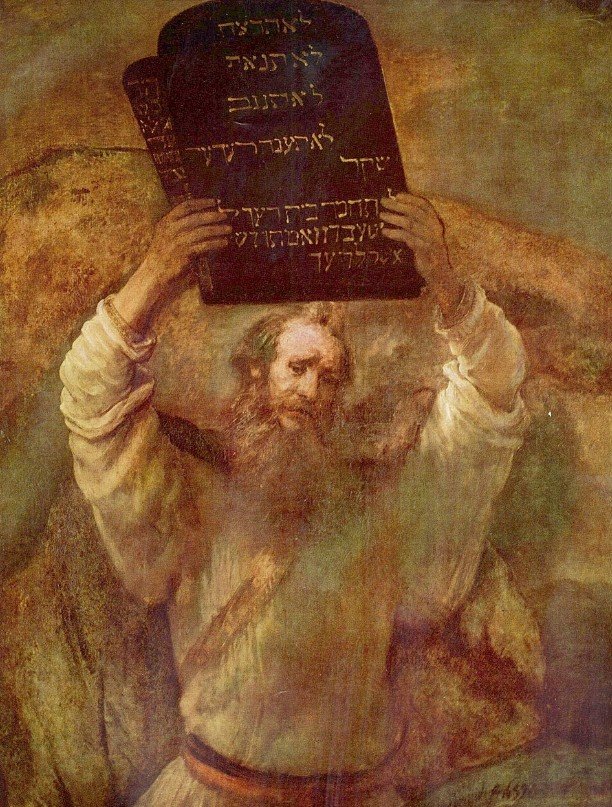
1 And God spake all these words, saying,…
4 Thou shalt not make unto thee any graven image, or any likeness of any thing that is in heaven above, or that is in the earth beneath, or that is in the water under the earth. 5 Thou shalt not bow down thyself to them, nor serve them: for I the LORD thy God am a jealous God, visiting the iniquity of the fathers upon the children unto the third and fourth generation of them that hate me; 6 And shewing mercy unto thousands of them that love me, and keep my commandments.
— Exodus 20:1,4-6 (KJV)
The second commandment forbids making images to bow down to and serve, including images meant to represent the true God. The first commandment tells us whom to worship. The second tells us how: not through objects made by human hands.
It sounds like a rule for ancient idol-makers. But it goes much deeper. It protects the way God chose to reveal Himself, it sits at the center of one of Christianity’s biggest divisions, and Bible prophecy says it will be tested again at the end of time.
Study this with your family or Sabbath School class.
Download the free 4-session printable guide, with comparison charts and a family worship activity.
Study it in pieces: the commandment phrase by phrase
The second commandment is the longest of the first three, and every phrase carries weight.
Here’s what each part means.
“Thou shalt not make unto thee any graven image”
A graven image is something carved, sculpted, or engraved. The phrase “unto thee” matters: it’s about images made for yourself, for your own use in worship. God later commanded carved cherubim for His sanctuary (Exodus 25:18-20), so the issue isn’t carving itself. It’s making an object to be your god or your way to God.
“Or any likeness of any thing”
The list covers everything: heaven above (sun, moon, stars, and angels), the earth beneath (people and animals), and the waters (fish and sea creatures). Moses later spelled this out in detail so no part of creation would become an object of worship (Deuteronomy 4:15-19).
Notice what’s missing: a likeness of God Himself. That’s because Israel had never seen one. “Ye heard the voice of the words, but saw no similitude” (Deuteronomy 4:12).
“Thou shalt not bow down thyself to them, nor serve them”
This phrase defines the sin. Bowing is the outward act of reverence. Serving includes devotion, offerings, prayers, and obedience.
God forbids both, not just “worship” in some narrow sense. That detail becomes important in the discussion later. When Cornelius bowed at Peter’s feet, Peter stopped him (Acts 10:25-26). When John bowed before an angel, the angel refused it (Revelation 19:10).
In Scripture, bowing in religious reverence is itself an act of worship.
“For I the LORD thy God am a jealous God”
God’s jealousy isn’t insecurity or envy.
It’s the protective love of a faithful husband who won’t share his wife with another lover. The prophets describe idolatry as adultery against a covenant partner (Jeremiah 3:20; Hosea 2:13-16). Paul felt the same “godly jealousy” for the church (2 Corinthians 11:2).
God even says His name is Jealous (Exodus 34:14). He knows idols can’t love us, save us, or answer us (Psalm 115:4-8). His jealousy guards a relationship that gives us life.
“Visiting the iniquity of the fathers upon the children … of them that hate me”
This does not mean God punishes innocent children for their parents’ sins. Scripture is direct: “the son shall not bear the iniquity of the father” (Ezekiel 18:20; Deuteronomy 24:16).
The key words are “of them that hate me.” When children continue their parents’ idolatry, they share its consequences. And idolatry passes down naturally through families as habits, beliefs, and ways of living.
Parents who bow to idols raise children who do the same.
“And shewing mercy unto thousands of them that love me”
Here is the good news tucked into the commandment. Judgment reaches three or four generations. Mercy reaches “thousands,” which Moses explains as “a thousand generations” (Deuteronomy 7:9). God’s mercy outweighs His judgment many times over.
For a mom, this is one of the most hopeful promises in the Ten Commandments. The faithfulness of one generation can bless a family line far into the future.
Case study: how Israel broke the second commandment in 40 days
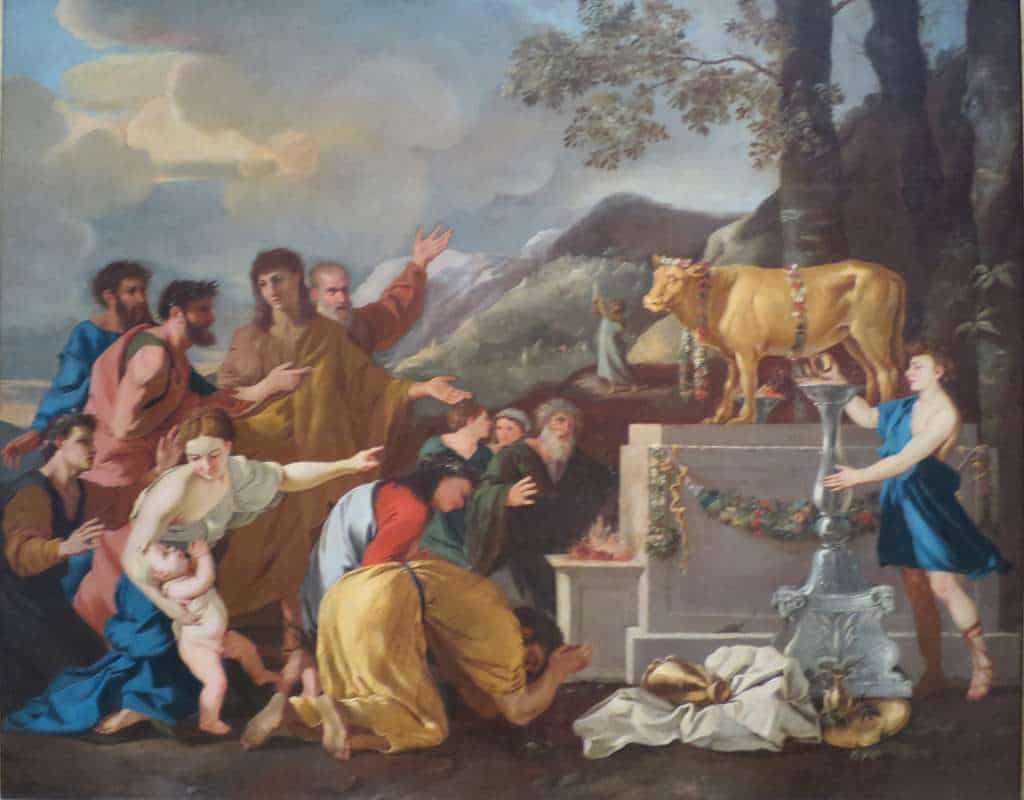
Israel heard God speak the second commandment aloud from Sinai (Exodus 20:1-6). Within weeks, at the foot of that same mountain, they broke it.
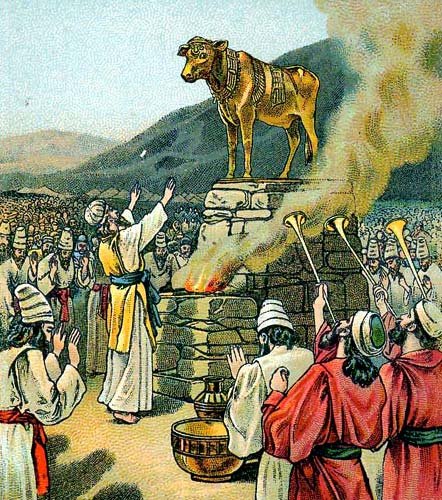
The golden calf shows exactly how image worship happens, and it rarely looks like open rebellion.
- It started with impatience. “Moses delayed to come down out of the mount” (Exodus 32:1). God felt far away, so the people wanted a god they could see.
- It borrowed from the culture around them. The gold came from Egypt (Exodus 12:35-36; 32:2-3), and many scholars connect the calf to Egypt’s bull cults. Israel reached for the familiar religious forms they had grown up around.
- It kept God’s name. Aaron declared, “These be thy gods, O Israel, which brought thee up out of the land of Egypt,” and announced “a feast to the LORD” (Exodus 32:4-5). They didn’t think they were abandoning the LORD. They thought they were worshiping Him in a new way.
- It led to moral collapse. The people “rose up to play,” and the feast turned into unrestrained revelry (Exodus 32:6, 25). Paul describes the same pattern: exchanging God’s glory for an image is followed by moral decline (Romans 1:22-24).
- Mercy came through a mediator. Moses pleaded for the people and even offered to be blotted out of God’s book in their place (Exodus 32:11-14, 31-32). His intercession points forward to Christ, who “ever liveth to make intercession” for us (Hebrews 7:25).
- God answered with His character, not an image. God wrote the commandments again on new tablets (Exodus 34:1). Then He passed before Moses and proclaimed His name: “merciful and gracious, longsuffering, and abundant in goodness and truth” (Exodus 34:5-7). Israel had made a picture of God. God answered by showing who He really is.
The story didn’t end there.
Centuries later, King Jeroboam set up two golden calves and used almost the same words: “behold thy gods, O Israel, which brought thee up out of the land of Egypt” (1 Kings 12:28). What began as one crowd’s impatience became the official religion of the northern kingdom.
The lesson: sincere intentions don’t make forbidden worship acceptable. God tells us how He wants to be worshiped, and we don’t get to redesign it (Deuteronomy 12:30-32; John 4:24).
Why God refuses to be pictured
Why is God so firm that no image may represent Him? Scripture gives several reasons, and they build on each other.
Israel saw no form.
At Sinai, God spoke from the fire, but the people saw nothing they could copy. Moses said this was deliberate, “lest ye corrupt yourselves, and make you a graven image” (Deuteronomy 4:12, 15-16).
No image can contain Him.
“God is a Spirit” (John 4:24). Even the highest heavens can’t contain Him, let alone a temple or a statue (1 Kings 8:27). “To whom then will ye liken God?” (Isaiah 40:18, 25). Any image shrinks Him to the size of human imagination. Paul told the Athenians that God is not “like unto gold, or silver, or stone, graven by art and man’s device” (Acts 17:29).
God has already made His image.
This is the deepest reason. God made humanity in his own image (Genesis 1:26-27). Every person you meet bears it (Genesis 9:6; James 3:9). And when God wanted to show us what He’s like, He didn’t send a statue. He sent His Son, “the image of the invisible God” (Colossians 1:15; Hebrews 1:3). Jesus said, “he that hath seen me hath seen the Father” (John 14:9).
God’s plan is to restore His image in us, so that believers are “changed into the same image” as Christ (2 Corinthians 3:18; Romans 8:29).
A carved image puts a lifeless object where God intended living people, and His living Son, to show His glory.
Ellen White made the same point about the purpose of this commandment:
“The second commandment forbids the worship of the true God by images or similitudes. Many heathen nations claimed that their images were mere figures or symbols by which the Deity was worshiped, but God has declared such worship to be sin.”
(Patriarchs and Prophets, p. 306)
The commandment that goes missing: why the lists are numbered differently
Scripture says there are exactly ten commandments (Exodus 34:28; Deuteronomy 4:13; 10:4).
In Hebrew they are literally the “ten words or statements.”
However, the original manuscript text doesn’t print a number beside each one, but it does show where each begins and ends.
Even so, different traditions have divided them in three main ways:
| What the commandment says | Jewish tradition | Catholic and Lutheran | Orthodox, Reformed, most Protestants, Adventists |
|---|---|---|---|
| I am the LORD, who brought you out of Egypt | 1 | Part of 1 | Preface/Part of 1 |
| No other gods before me | 2 | 1 | 1 |
| No graven images | Part of 2 | Part of 1 | 2 |
| Don’t take God’s name in vain | 3 | 2 | 3 |
| Remember the Sabbath day | 4 | 3 | 4 |
| Honor your father and mother | 5 | 4 | 5 |
| Don’t murder | 6 | 5 | 6 |
| Don’t commit adultery | 7 | 6 | 7 |
| Don’t steal | 8 | 7 | 8 |
| Don’t bear false witness | 9 | 8 | 9 |
| Don’t covet your neighbor’s wife | Part of 10 | 9 | Part of 10 |
| Don’t covet your neighbor’s goods | Part of 10 | 10 | Part of 10 |
The Catholic and Lutheran numbering comes from Augustine in the 400s. It treats “no other gods” and “no graven images” as one commandment about worship, then splits the command against coveting into two. That keeps the total at ten.
To be fair: the Catholic Church doesn’t remove the words about images from the Bible. Catholic Bibles contain Exodus 20:4-6 in full, and the Catechism of the Catholic Church prints the full Exodus text. So Catholics recognize the full text, but promote another version.
The short list many Catholics use reads only, “I am the LORD your God: you shall not have strange gods before me.” In that familiar summary, the prohibition on bowing to images never appears.
Why this matters to Adventists.
Numbering by itself is a matter of tradition. But a summary that leaves out the words about images, used by a church that encourages bowing before images, raises a serious question. God warned, “Ye shall not add unto the word which I command you, neither shall ye diminish ought from it” (Deuteronomy 4:2).
Daniel’s prophecy describes a power that would “think to change times and laws” (Daniel 7:25). Adventists understand that prophecy to describe the medieval papacy, whose changes to God’s law include both the handling of images and the move from the seventh-day Sabbath to Sunday.
The Ten Commandments should be taught the way God spoke them, every word included.
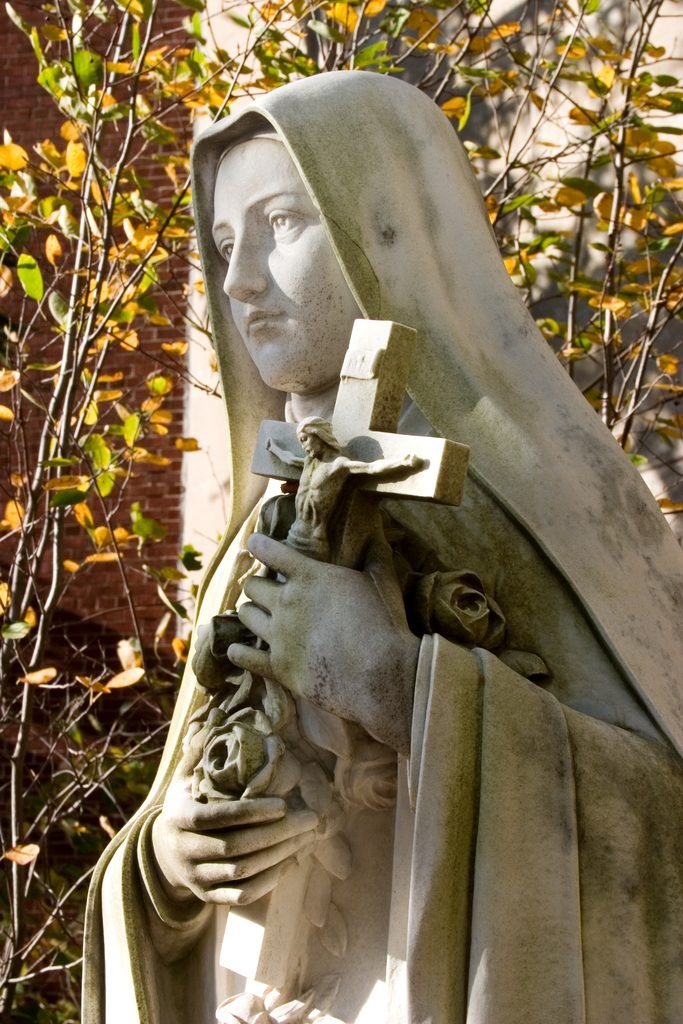
Do Catholics worship idols?
This is a sensitive question, and it deserves a careful answer. Let’s hear the Catholic position in its own terms first.
What the Catholic Church teaches.
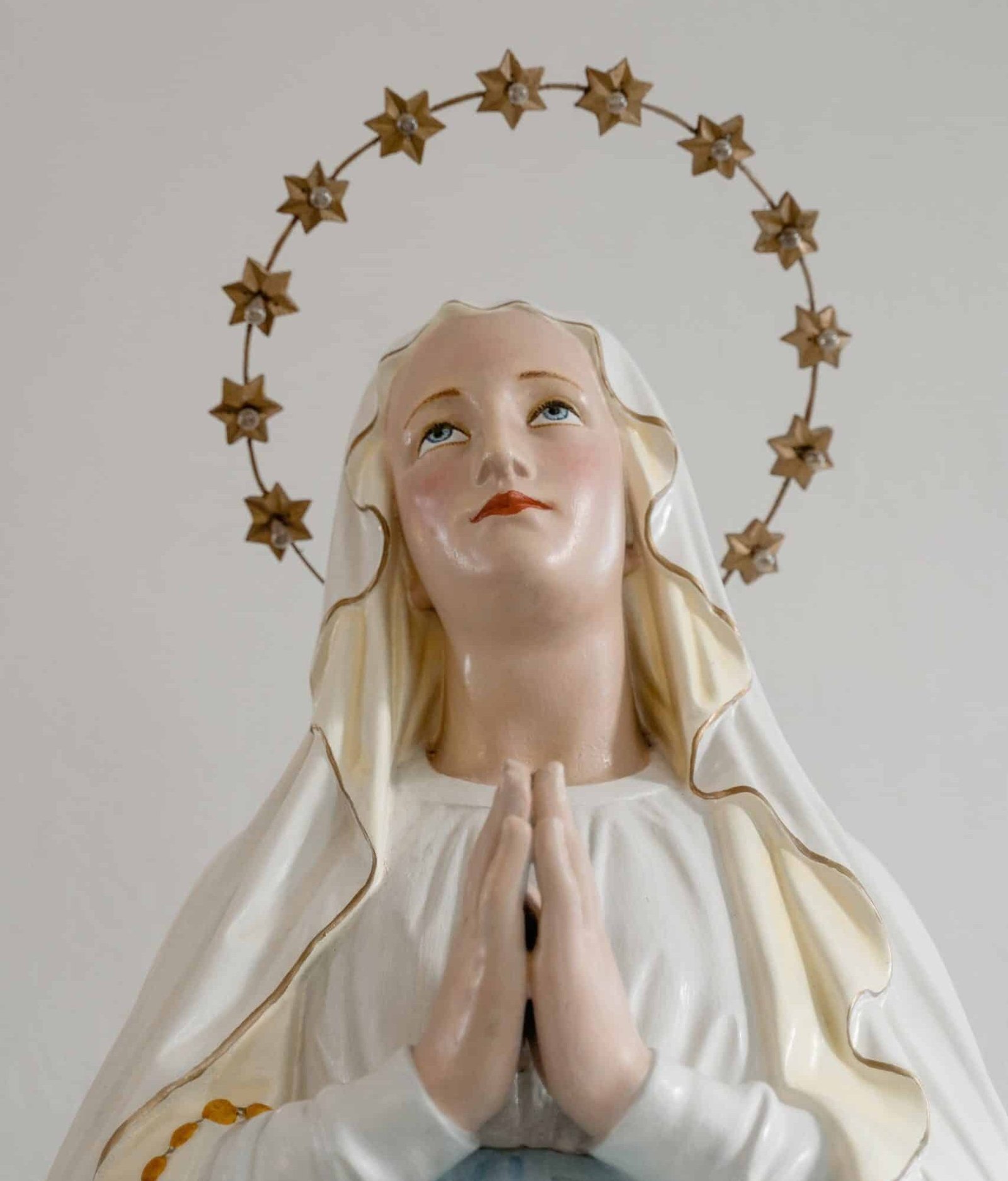
Catholic teaching distinguishes between latria, the adoration owed to God alone, and dulia, the honor given to saints (with hyperdulia, a higher honor, given to Mary). The Church teaches that veneration of images isn’t idolatry, because the honor given to an image passes on to the person it represents.
It points to the Second Council of Nicaea (AD 787) and argues that because God became visible in Jesus, Christ may now be depicted (Catechism, paragraphs 2129-2132). Catholics sincerely believe they worship God alone.
How Scripture answers.
Adventists and many Protestants respond with four points from the Bible:
- The commandment forbids bowing, not only adoring. “Thou shalt not bow down thyself to them, nor serve them” (Exodus 20:5). It makes no exception for bowing that intends honor rather than worship. Peter and the angel refused even respectful bowing (Acts 10:25-26; Revelation 19:10).
- Symbolic intent didn’t excuse Israel. The golden calf was offered as a symbol of the LORD, with “a feast to the LORD” (Exodus 32:4-5). Good intentions didn’t make it acceptable.
- Praying to saints assumes the dead are conscious. Scripture teaches that “the dead know not any thing” and rest until the resurrection (Ecclesiastes 9:5-6; Psalm 146:4; 1 Thessalonians 4:13-16; Fundamental Belief 26). If the saints are asleep, they aren’t hearing prayers.
- Jesus is the only mediator we need. There is “one mediator between God and men, the man Christ Jesus” (1 Timothy 2:5). He “ever liveth to make intercession” for us, so we can come to God through Him directly (Hebrews 7:25).
- Good objects can become idols. Israel burned incense to the bronze serpent God Himself had commanded, until Hezekiah destroyed it (Numbers 21:8-9; 2 Kings 18:4). An object’s holy origin doesn’t make bowing to it safe.
A word of grace.
Many Catholics love Jesus sincerely and follow Him according to the light they have. To them they are not aware or convicted about this. And Adventists are critiquing the teachings, not the hearts of individual believers.
God judges each person by the light received (John 9:41; James 4:17), and He calls His people everywhere to follow His Word fully (Revelation 18:4).
The second commandment in Bible prophecy
The second commandment isn’t only about Israel’s past. Scripture shows it will be tested again, openly, before the end.
Daniel 3: the first image test. King Nebuchadnezzar set up a golden image and commanded everyone to bow when the music played. The penalty for refusing was the fiery furnace. Three young Hebrews refused: “we will not serve thy gods, nor worship the golden image which thou hast set up” (Daniel 3:1-6, 18). God met them in the fire.
Revelation 13: the final image test. Revelation describes an “image to the beast” and a decree that everyone who refuses to worship it should be killed (Revelation 13:14-15). The parallels with Daniel 3 are striking: an image, a worldwide command, and a death decree.
Adventists understand the image of the beast not as a literal statue but as a religious-political power modeled on the first beast, using civil law to enforce religious observance. The final test will again be the question of the first two commandments: whom will you worship, and how?
God’s answer is the same as at Sinai. The three angels of Revelation 14 call the world to “worship him that made heaven, and earth” and warn against worshiping the beast and his image (Revelation 14:7, 9-11). God’s people are described as those who “keep the commandments of God, and the faith of Jesus” (Revelation 14:12).
Like the three Hebrews, they will stand.
What the second commandment does not forbid
Some Christians apply this commandment more broadly than Scripture does.
The test in every case is the commandment’s own words: is the object made or used to be bowed to and served?
| Common question | What Scripture shows |
|---|---|
| Is all religious art forbidden? | No. God commanded golden cherubim, embroidered pomegranates, and carved palm trees and flowers for His sanctuary, and filled Bezalel with His Spirit to make them (Exodus 25:18-20; 28:33; 31:1-5; 1 Kings 6:29). |
| Are pictures of Jesus wrong? | Christians disagree. Adventist publishing has long used paintings of Christ to teach Bible stories, and a teaching illustration isn’t bowed to or served. But no picture shows what Jesus actually looked like, and any image that becomes an object of devotion crosses the line (Deuteronomy 4:15-19). |
| Is a cross an idol? | Not by itself. A cross that reminds us of Christ’s sacrifice is a symbol (Galatians 6:14). It becomes an idol when people bow to it, pray to it, or treat it as having power, as Israel did with the bronze serpent (2 Kings 18:4). |
| Are family photos or statues in a park idols? | No. The commandment is about religious devotion. Honoring someone’s memory isn’t the same as bowing to and serving an image. |
| Is it fine if an image helps me worship God? | No. That was the golden calf’s exact reasoning (Exodus 32:4-5). God sets how He is to be worshiped: “in spirit and in truth” (John 4:24). |
| Can hobbies, games, or money become idols? | Yes. Anything we love, trust, or serve more than God takes His place (Colossians 3:5; Matthew 6:21, 24; 1 John 5:21). |
Living the second commandment
Most of us will never be ordered to bow before a golden statue. But the second commandment trains us now for the day we might be. It asks whether we’ll let God define how we worship Him, even when a visible, familiar, or popular way seems easier.
I love Asian art, and I’ve decorated with wood block prints and other pieces for years. My mom once gave me a small ceramic head of the Buddha for the garden, about a foot tall. I thought it looked cool. And it was a thoughtful gift reflecting my interests in art and gardening. I never bowed to it, prayed to it, or even thought about it. It was just decoration.
Then one day my husband asked me how I felt about having it. At first I didn’t see the problem. I wasn’t worshiping it. But the more I thought about it, the more I realized he was right.
That statue wasn’t just a pretty shape. It was an image of someone millions of people bow to and pray to. It was made to be an object of devotion, even if it wasn’t one for me.
So I threw it out. It wasn’t because I was afraid of it or looked down on the people who honor it.
It was because I didn’t want an image of another god to have a place in my home, even a quiet one in the garden (Deuteronomy 7:25-26). That moment changed how I think about this commandment.
It isn’t only about what I bow to. It’s also about what I welcome in and give a place of honor.
Learn more about the Ten Commandments.
Take away: 6 things to remember
- The command: Don’t make images to bow to or serve, including images of the true God (Exodus 20:4-5).
- The reason: God is spirit, and He has already made His image in humanity and revealed it fully in Jesus (Genesis 1:27; Colossians 1:15).
- The warning: Israel broke it within 40 days while claiming to honor the LORD (Exodus 32:4-5).
- The division: Traditions number the commandments differently, but God’s words should be taught without removing any (Deuteronomy 4:2).
- The future: The final test in Revelation involves worship and an image, just as in Daniel 3 (Revelation 13:14-15; 14:9-12).
- The promise: God’s mercy reaches a thousand generations of those who love Him (Deuteronomy 7:9).
Study For yourself about idols
Get our free, printable four-session guide, complete with comparison charts and a family worship activity.

Our Adventist Life is a dedicated online evangelist and mother of two, deeply rooted in her Seventh-day Adventist faith. With over 15 years of experience in creating and optimizing digital content, she brings a unique blend of professional expertise and spiritual insight to her work. Her passion lies in exploring Biblical truths and their practical applications in daily living, self-care, and family nurturing. Through her writing, she aims to inspire and guide her readers toward a more fulfilling Christian lifestyle, drawing from her own experiences as a parent and a follower of Christ. Her thoughtful and engaging content reflects her commitment to sharing the love and wisdom found in the Scriptures with a modern audience living in the end times.