
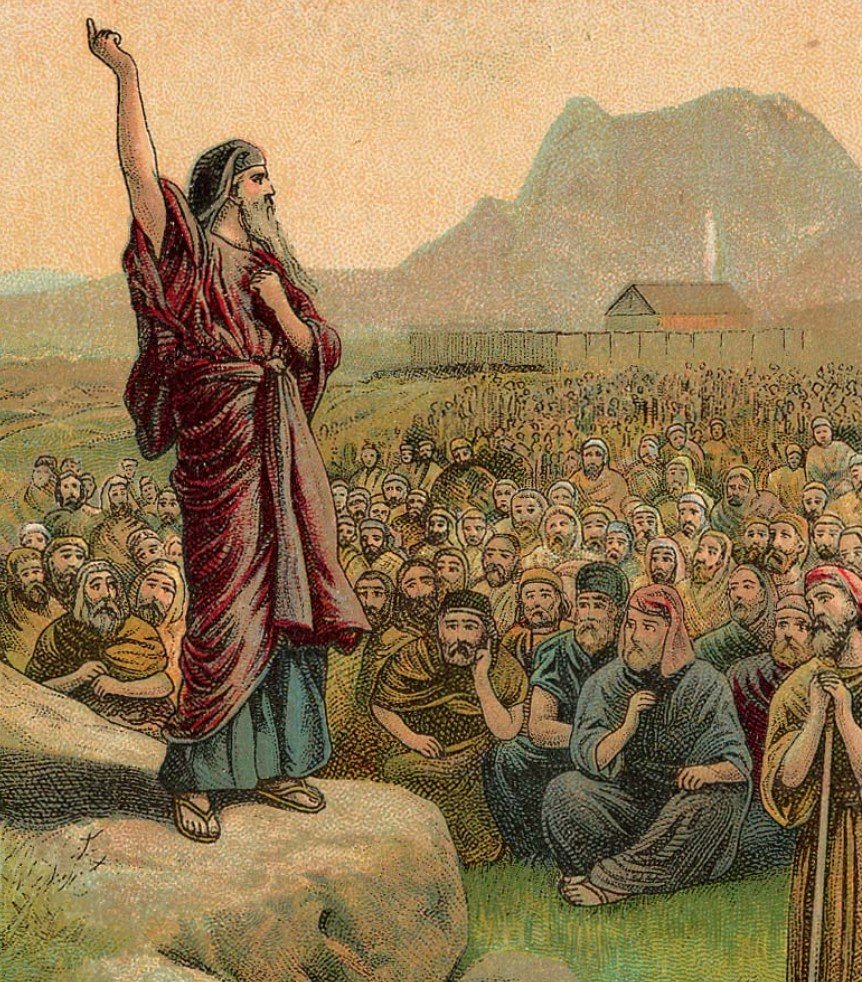
1 And God spake all these words, saying,
2 I am the LORD thy God, which have brought thee out of the land of Egypt, out of the house of bondage. 3 Thou shalt have no other gods before me.
— Exodus 20:1-3 (KJV)
The first commandment means God alone deserves our worship, trust, and first loyalty. But it doesn’t begin with a demand. It begins with a rescue: God saves His people first, then asks for their hearts.
This study follows the commandment step by step, from Mount Sinai to the last book of the Bible. Along the way, it shows why worship is the issue at the center of the whole Bible story.
Want to study this with your family or Sabbath School class?
Download the free 5-part printable study guide, with verse lookups, discussion questions, and a family worship activity.
Step 1: The commandment begins with a rescue, not a rule
Before any “thou shalt,” God introduces Himself. He gives His name, the LORD (YHWH, the great “I AM” of Exodus 3:14), and reminds Israel what He has done.
The order matters.
God didn’t tell Israel to obey so He would free them. He had already freed them. Obedience was their response to a Savior who had proven He could be trusted (Exodus 19:4-6; Deuteronomy 5:6).
The same order holds for Christians today. Paul describes believers as rescued “from the power of darkness” and grafted into God’s people (Colossians 1:13; Romans 11:17-24). Egypt pictures every kind of slavery sin creates.
When God says, “I brought thee out,” every believer can answer, “You brought me out too.”
Jesus confirmed that this commandment still stands.
When asked which commandment comes first, He quoted Deuteronomy 6:4-5 and applied it to everyone listening (Mark 12:29-30).
Step 2: What “before me” really means
The Hebrew phrase translated “before me” (‘al-panay) literally means “before my face” or “in my presence.”
It doesn’t mean “put me first on your list of gods.” It means nothing may stand in God’s presence as His rival. And God’s presence is everywhere (Psalm 139:7-10). There is no corner of life where another god could sit “out of His sight.” The commandment covers everything.
That rules out three ways people in the ancient world thought about the divine, and each still has modern versions:
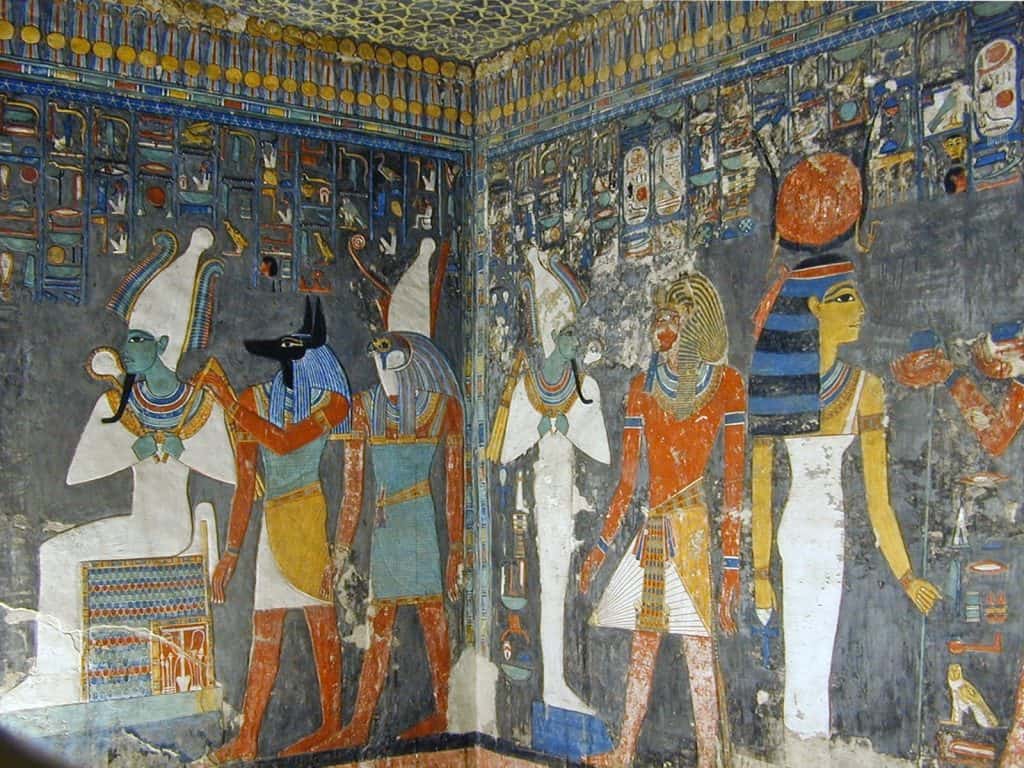
- Polytheism is the belief in many gods, each ruling its own area. In Athens, Paul even found an altar “to the unknown god,” built in case one had been missed (Acts 17:22-23).
- Henotheism is worshiping one god while assuming others are real too. God answers it directly: “beside me there is no God” (Isaiah 44:6).
- Inclusive monotheism is the idea that all gods are one god under different names, the way Romans equated Jupiter with the Greek Zeus. Scripture ties knowing God to knowing Him as He has actually revealed Himself (John 17:3; Galatians 1:6-9).
Step 3: Why only the Creator deserves worship
The Bible gives a simple test for who is truly God: the One who made everything. “For all the gods of the nations are idols: but the LORD made the heavens” (Psalm 96:5; see also Jeremiah 10:10-12). In heaven, worship rests on the same reason: “thou hast created all things” (Revelation 4:11).
This is where the first commandment connects to the fourth.
The Sabbath commandment explains itself this way: “in six days the LORD made heaven and earth, the sea, and all that in them is” (Exodus 20:11). The first commandment tells us whom to worship. The Sabbath marks Him as Creator every week.
Revelation brings the two together.
The first angel’s message calls the whole world to “worship him that made heaven, and earth, and the sea, and the fountains of waters” (Revelation 14:7). That wording echoes Exodus 20:11 closely.
Seventh-day Adventists see in this echo a clue that, at the end of time, God’s call will be the first commandment again, pointing back to the Creator and His Sabbath.
Step 4: Worship is the center of the great controversy
Why would God put exclusive worship first? Because worship is what the conflict between God and Satan is about.
Follow the thread through Scripture:
- The first rebellion. Lucifer wanted God’s place: “I will be like the most High” (Isaiah 14:12-14; Ezekiel 28:12-17).
- The first temptation. The serpent promised Eve, “ye shall be as gods” (Genesis 3:4-5). The lie was that humans could take God’s place too.
- The temptation of Jesus. Satan offered Christ every kingdom of the world “if thou wilt fall down and worship me.” Jesus answered with the first commandment: “Thou shalt worship the Lord thy God, and him only shalt thou serve” (Matthew 4:8-10; Deuteronomy 6:13).
- The final crisis. Revelation 13 describes the world pressured to worship the beast and its image. Revelation 14 answers with God’s call to worship the Creator (Revelation 13:4, 8, 15; 14:7, 9-12).
So the first commandment isn’t just one rule among ten. It asks the question every person will finally answer: whom will I worship?
Adventists call this Bible-wide story the great controversy (Fundamental Belief 8).
Ellen White summed up the first commandment this way:
“Jehovah, the eternal, self-existent, uncreated One, Himself the Source and Sustainer of all, is alone entitled to supreme reverence and worship. … Whatever we cherish that tends to lessen our love for God or to interfere with the service due Him, of that do we make a god.”
(Patriarchs and Prophets, p. 305)
Step 5: How we break the first commandment today
Few of us will ever bow to a statue of Baal. But anything can slide into God’s place.
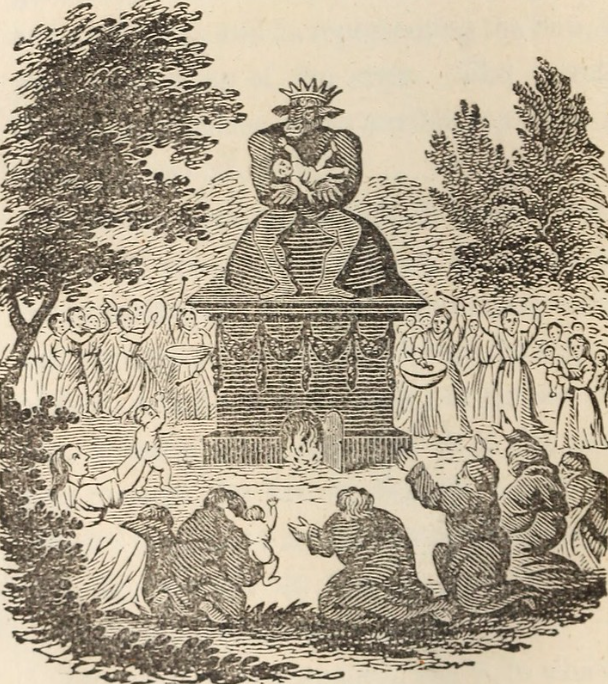
- Self. Paul warned that in the last days people would be “lovers of their own selves … lovers of pleasures more than lovers of God” (2 Timothy 3:2-4). Even our appetites can become a god (Philippians 3:19).
- Money and security. “Ye cannot serve God and mammon” (Matthew 6:24). Paul calls covetousness idolatry (Colossians 3:5).
- People. Family, celebrities, political leaders, and even pastors can receive trust that belongs to God alone (Jeremiah 17:5-7; Matthew 10:37).
- A god of our own design. We can keep the name “God” but reshape Him to suit us, keeping His mercy and discarding His commands. God rebuked this: “thou thoughtest that I was altogether such an one as thyself” (Psalm 50:21). The golden calf was even celebrated as “a feast to the LORD” (Exodus 32:4-5).
- The spirits of the dead. Scripture teaches that the dead “know not any thing” and rest until the resurrection (Ecclesiastes 9:5-6; Psalm 146:4; John 11:11-14; 1 Thessalonians 4:13-16). If the dead aren’t conscious, then spirits claiming to be departed loved ones, saints, or ancestors are not who they claim to be. God forbids seeking the dead (Deuteronomy 18:10-12; Isaiah 8:19-20). Praying to the dead, venerating ancestors, or consulting mediums gives spiritual trust to something other than God. It all traces back to the serpent’s first lie: “Ye shall not surely die” (Genesis 3:4; Fundamental Belief 26).
Hard questions about the first commandment
Some scholars argue that early Israel believed other gods were real and simply chose to worship only the LORD.
But the Bible separates two things: spiritual beings that exist and gods that are truly God.
Paul holds both together. “An idol is nothing in the world,” and “though there be that are called gods … to us there is but one God” (1 Corinthians 8:4-6). Yet he also warns that sacrifices to idols are offered “to devils” (1 Corinthians 10:19-20; Deuteronomy 32:16-17). Real beings stand behind false worship, but none of them is God.
The Old Testament says the same thing plainly: “the LORD he is God … there is none else” (Deuteronomy 4:35, 39; Isaiah 45:21-22).
Forbidding worship of something doesn’t make it real, any more than warning about counterfeit money makes it legal tender.
God’s people knew this commandment long before Sinai.
Jacob told his household to “put away the strange gods” before meeting God at Bethel (Genesis 35:2-4). God said Abraham “kept … my commandments, my statutes, and my laws” (Genesis 26:5). Joshua later reminded Israel that Abraham’s family once served other gods and that they had to choose (Joshua 24:2, 14-15).
Sinai put in writing what God had always asked. And the New Testament never retires it.
Jesus called it the first commandment (Mark 12:29-30) and said He didn’t come to destroy the law (Matthew 5:17-19). Paul wrote that faith establishes the law rather than voiding it (Romans 3:31; Fundamental Belief 19).
Seventh-day Adventists believe in one God: Father, Son, and Holy Spirit (Fundamental Belief 2). The Shema says “the LORD our God is one LORD” (Deuteronomy 6:4).
The Hebrew word for “one,” echad, is the same word used when husband and wife become “one flesh” (Genesis 2:24). It can describe a unity of more than one.
The New Testament names all three together, under one name: “in the name of the Father, and of the Son, and of the Holy Ghost” (Matthew 28:19; see also Matthew 3:16-17; 2 Corinthians 13:14). It calls Jesus God (John 1:1, 14; John 20:28) and the Holy Spirit God (Acts 5:3-4).
This matters for the first commandment. Angels and apostles refused worship (Revelation 19:10; Acts 10:25-26), but Jesus accepted it (Matthew 14:33; John 20:28). If Jesus weren’t God, worshiping Him would break the first commandment.
Because He is, worshiping Him keeps it.
How God is three and one is beyond full human explanation, and Scripture doesn’t try to explain it all (Deuteronomy 29:29).
You may see 1 John 5:7 quoted on this question. Its wording about “three that bear record in heaven” isn’t found in the earliest Greek manuscripts, so this study relies on passages that aren’t disputed.
All three faiths trace themselves to Abraham and speak of one Creator God. Projects like the Abrahamic Family House in Abu Dhabi, which places a synagogue, church, and mosque side by side, express the hope that these differences don’t finally matter.

The Bible’s question is whether our picture of God is true to how He has revealed Himself. Jesus said, “He that honoureth not the Son honoureth not the Father which hath sent him” (John 5:23; see also 1 John 2:23; John 14:6; Acts 4:12). Judaism doesn’t accept Jesus as the Messiah. Islam honors Jesus as a prophet but denies that He is the Son of God and that He died on the cross.
These aren’t small details. They are about who God is and how He saves.
That doesn’t mean people in other faiths are insincere or out of God’s reach. Paul told the Athenians that God “winked at” past ignorance and now calls everyone to repent (Acts 17:30).
Jesus spoke of “other sheep” not yet in His fold (John 10:16). Adventists believe God judges people by the light they have received (John 9:41; James 4:17; Romans 2:14-16).
The first commandment calls every sincere seeker toward the fuller truth about God revealed in Jesus.
Scripture points to two sources of false worship.
One is human invention: people shaping gods from their own ideas and hands (Isaiah 44:9-20; Romans 1:21-23).
The other is demonic deception working behind idols (1 Corinthians 10:20; Deuteronomy 32:17; 2 Corinthians 11:14).
So the Bible doesn’t claim Lucifer personally designed every deity. It shows him using any worship that turns away from the true God, whatever its origin. That’s why many religions still contain moral truths (Romans 2:14-15) while missing the Savior.
When a human demands worship, it’s arrogance, because no human deserves it. God is the only One who does. He made us, sustains us, and died to save us.
Exclusive worship is also for our good. God calls other gods “broken cisterns, that can hold no water” (Jeremiah 2:13). And we become like what we worship (Psalm 115:4-8). God asks for our whole heart the way a faithful spouse does, because divided love destroys the relationship (Jeremiah 3:20; 2 Corinthians 11:2).
Read more about God’s jealousy in our study of the second commandment.
God invites the test.
He challenges idols to predict the future and declares that He alone announces “the end from the beginning” (Isaiah 41:21-23; Isaiah 46:9-10). Bible prophecy, such as the sequence of world empires in Daniel 2 and the Messiah’s birthplace in Micah 5:2, lets us check His track record.
Creation also points to its Maker (Psalm 19:1; Romans 1:20). The resurrection of Jesus was backed by named eyewitnesses, many still alive when Paul wrote (1 Corinthians 15:3-8).
And God invites personal experience: “O taste and see that the LORD is good” (Psalm 34:8).
Living the first commandment
Keeping the first commandment isn’t mainly about avoiding statues. It’s about what gets first place in an ordinary day: the first thought in the morning, the first claim on our time and money, the first place we turn when we’re afraid.
Jesus gave the simplest test: “seek ye first the kingdom of God, and his righteousness; and all these things shall be added unto you” (Matthew 6:33). And He reminded us that our hearts follow our treasure (Matthew 6:21).
For me, it wasn’t a statue. It was a game. I’d tell myself, “Just one more match,” or “Just one more quest,” and then I’d look up and the evening was gone. The things that mattered more, the ones I kept meaning to get to, never seemed to get their turn.
The hardest part to admit was what slipped first: my time in the Bible. I never decided to stop reading it. I just kept choosing something else first, one small choice at a time. Nothing about a game is evil, but I had given it the first place in my time, and that place belongs to God.
That’s when this commandment stopped feeling like an ancient warning about idols of wood and stone. Anything can quietly move into first place, even something harmless. Now I try to give God the first of my day before anything else gets a turn. And I’ve found that He is far better company than one more quest.
Learn more about the Ten Commandments.
Summary breakdown: the first commandment in five parts
- God rescues first, then asks for our hearts (Exodus 20:2).
- “Before me” means nothing may stand as God’s rival anywhere, because He is everywhere (Psalm 139:7-10).
- Only the Creator deserves worship, which ties this commandment to the Sabbath (Exodus 20:11; Revelation 14:7).
- Worship is the center of the conflict between Christ and Satan, from Eden to the end (Isaiah 14:14; Matthew 4:10; Revelation 14:7).
- Anything we put first, including self, money, people, or the dead, can become another god (Colossians 3:5; Isaiah 8:19-20).
Study for Yourself this topic
Get our printable study guide, that includes every verse with space for your notes.
Bible verses on the one true God
Here are 28 Bible passages that teach there is only one God. The passages are quoted from the King James Version (bold added for emphasis):
- Deuteronomy 4:35-39 – “Unto thee it was shewed, that thou mightest know that the LORD he is God; there is none else beside him.
Out of heaven he made thee to hear his voice, that he might instruct thee: and upon earth he shewed thee his great fire; and thou heardest his words out of the midst of the fire.
And because he loved thy fathers, therefore he chose their seed after them, and brought thee out in his sight with his mighty power out of Egypt;
To drive out nations from before thee greater and mightier than thou art, to bring thee in, to give thee their land for an inheritance, as it is this day.
Know therefore this day, and consider it in thine heart, that the LORD he is God in heaven above, and upon the earth beneath: there is none else.“ - Deuteronomy 6:4 – “Hear, O Israel: The LORD our God is one LORD:“
- Deuteronomy 32:39 – “See now that I, even I, am he, and there is no god with me: I kill, and I make alive; I wound, and I heal: neither is there any that can deliver out of my hand.”
- 2 Samuel 7:22 – “Wherefore thou art great, O LORD God: for there is none like thee, neither is there any God beside thee, according to all that we have heard with our ears.“
- 1 Kings 8:60 – “That all the people of the earth may know that the LORD is God, and that there is none else.“
- 2 Kings 5:15 (KJV) – “And he returned to the man of God, he and all his company, and came, and stood before him: and he said, Behold, now I know that there is no God in all the earth, but in Israel: now therefore, I pray thee, take a blessing of thy servant.”
- 2 Kings 19:15 – “And Hezekiah prayed before the LORD, and said, O LORD God of Israel, which dwellest between the cherubims, thou art the God, even thou alone, of all the kingdoms of the earth; thou hast made heaven and earth.”
- 1 Chronicles 17:20 – “O LORD, there is none like thee, neither is there any God beside thee, according to all that we have heard with our ears.”
- Nehemiah 9:6 – “Thou, even thou, art LORD alone; thou hast made heaven, the heaven of heavens, with all their host, the earth, and all things that are therein, the seas, and all that is therein, and thou preservest them all; and the host of heaven worshippeth thee.”
- Psalm 18:31 – “For who is God save the LORD? or who is a rock save our God?”
- Psalm 86:10 – “For thou art great, and doest wondrous things: thou art God alone.”
- Isaiah 37:16-20 – “O LORD of hosts, God of Israel, that dwellest between the cherubims, thou art the God, even thou alone, of all the kingdoms of the earth: thou hast made heaven and earth.
Incline thine ear, O LORD, and hear; open thine eyes, O LORD, and see: and hear all the words of Sennacherib, which hath sent to reproach the living God.
Of a truth, LORD, the kings of Assyria have laid waste all the nations, and their countries,
And have cast their gods into the fire: for they were no gods, but the work of men’s hands, wood and stone: therefore they have destroyed them.
Now therefore, O LORD our God, save us from his hand, that all the kingdoms of the earth may know that thou art the LORD, even thou only.” - Isaiah 43:10-11 – “Ye are my witnesses, saith the LORD, and my servant whom I have chosen: that ye may know and believe me, and understand that I am he: before me there was no God formed, neither shall there be after me.
I, even I, am the LORD; and beside me there is no saviour.” - Isaiah 44:6-8 – “Thus saith the LORD the King of Israel, and his redeemer the LORD of hosts; I am the first, and I am the last; and beside me there is no God.
And who, as I, shall call, and shall declare it, and set it in order for me, since I appointed the ancient people? and the things that are coming, and shall come, let them shew unto them.
Fear ye not, neither be afraid: have not I told thee from that time, and have declared it? ye are even my witnesses. Is there a God beside me? yea, there is no God; I know not any.“ - Isaiah 45:21 – “Tell ye, and bring them near; yea, let them take counsel together: who hath declared this from ancient time? who hath told it from that time? have not I the LORD? and there is no God else beside me; a just God and a Saviour; there is none beside me.”
- Isaiah 46:9 – “Remember the former things of old: for I am God, and there is none else; I am God, and there is none like me,”
- Hosea 13:4 – “Yet I am the LORD thy God from the land of Egypt, and thou shalt know no god but me: for there is no saviour beside me.”
- Joel 2:27 – “And ye shall know that I am in the midst of Israel, and that I am the LORD your God, and none else: and my people shall never be ashamed.”
- Zechariah 14:9 – “And the LORD shall be king over all the earth: in that day shall there be one LORD, and his name one.”
- Mark 12:29-34 – “And Jesus answered him, The first of all the commandments is, Hear, O Israel; The Lord our God is one Lord:
And thou shalt love the Lord thy God with all thy heart, and with all thy soul, and with all thy mind, and with all thy strength: this is the first commandment.
And the second is like, namely this, Thou shalt love thy neighbour as thyself. There is none other commandment greater than these.
And the scribe said unto him, Well, Master, thou hast said the truth: for there is one God; and there is none other but he:
And to love him with all the heart, and with all the understanding, and with all the soul, and with all the strength, and to love his neighbour as himself, is more than all whole burnt offerings and sacrifices.
And when Jesus saw that he answered discreetly, he said unto him, Thou art not far from the kingdom of God. And no man after that durst ask him any question.” - John 17:3 – “And this is life eternal, that they might know thee the only true God, and Jesus Christ, whom thou hast sent.“
- Romans 3:30 – “Seeing it is one God, which shall justify the circumcision by faith, and uncircumcision through faith.”
- 1 Corinthians 8:4-6 – “As concerning therefore the eating of those things that are offered in sacrifice unto idols, we know that an idol is nothing in the world, and that there is none other God but one.
For though there be that are called gods, whether in heaven or in earth, (as there be gods many, and lords many,)
But to us there is but one God, the Father, of whom are all things, and we in him; and one Lord Jesus Christ, by whom are all things, and we by him.” - Galatians 3:20 – “Now a mediator is not a mediator of one, but God is one.”
- Ephesians 4:6 – “One God and Father of all, who is above all, and through all, and in you all.”
- 1 Timothy 1:17 – “Now unto the King eternal, immortal, invisible, the only wise God, be honour and glory for ever and ever. Amen.”
- 1 Timothy 2:5 – “For there is one God, and one mediator between God and men, the man Christ Jesus;”
- James 2:19 – “Thou believest that there is one God; thou doest well: the devils also believe, and tremble.”
Know of a verse we are missing? Let us know.

Our Adventist Life is a dedicated online evangelist and mother of two, deeply rooted in her Seventh-day Adventist faith. With over 15 years of experience in creating and optimizing digital content, she brings a unique blend of professional expertise and spiritual insight to her work. Her passion lies in exploring Biblical truths and their practical applications in daily living, self-care, and family nurturing. Through her writing, she aims to inspire and guide her readers toward a more fulfilling Christian lifestyle, drawing from her own experiences as a parent and a follower of Christ. Her thoughtful and engaging content reflects her commitment to sharing the love and wisdom found in the Scriptures with a modern audience living in the end times.